Solitaire Word Associations
- 4.7
- Rating
- 50.00K
- Installs
- Free
- Price
 Analysis by App-foxy
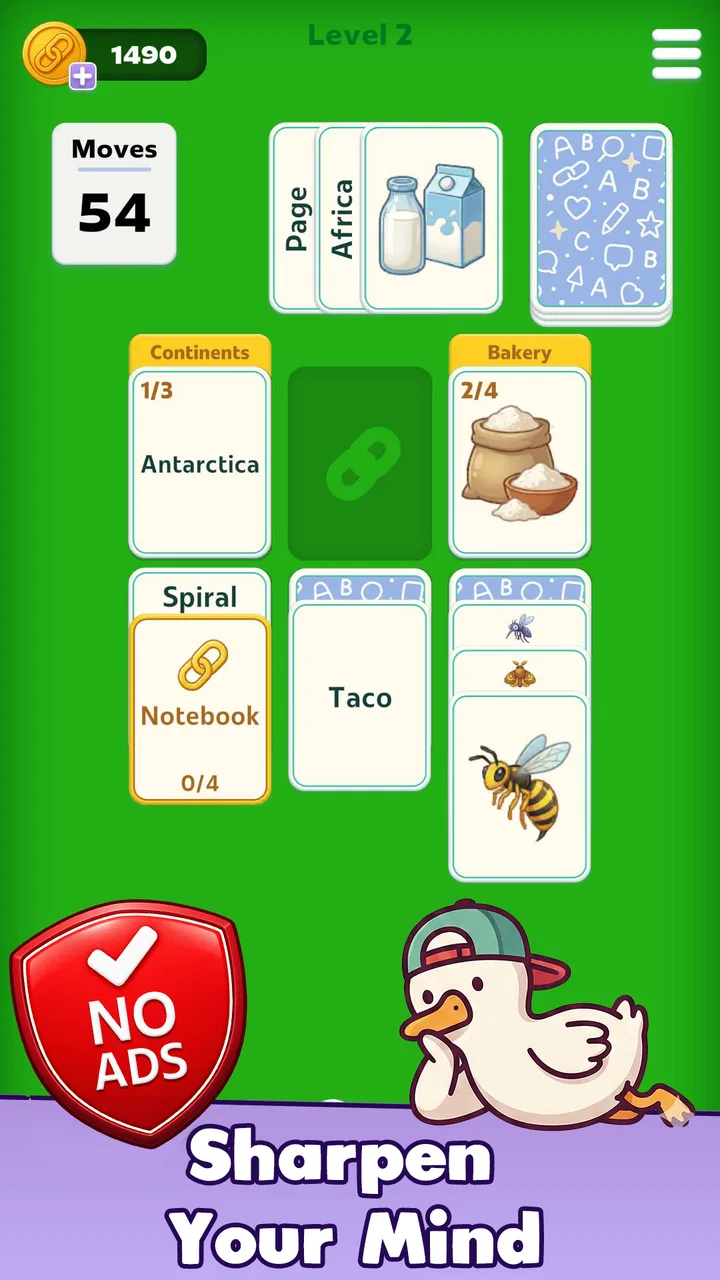
I spent time with Solitaire Word Associations as a quiet word game, and its appeal became clear very quickly: it asks me to make connections between words without surrounding the session with noise. Developed by SNG Games, it belongs to the word-game category, but it feels less like a race against a clock and more like a small mental reset. The basic idea is easy to understand, yet the format gives me enough room to think rather than forcing every move into a frantic routine.
That makes it a particularly interesting choice for people who enjoy word puzzles but do not want the pressure of competitive leaderboards, rapid-fire rounds, or a crowded interface. I can pick it up when I have a few spare minutes, follow a chain of associations, and put it down without feeling that I have abandoned a complicated challenge. At the same time, the relaxed design will not satisfy everyone. Players who want deep vocabulary research, elaborate progression, or constant novelty may find the experience intentionally narrow.
How the word-association format feels in everyday use
The game is built around a simple mental task: seeing how words relate to one another. That simplicity is its strongest starting point. I do not need a tutorial-heavy introduction to understand what I am supposed to do, and the low barrier makes it suitable for casual players who might normally avoid word games. The challenge comes from interpretation rather than from learning a complicated control scheme.
You May Also Like

 Blood Strike: 2.5 Anniversary
Blood Strike’s Loadouts Turn Every Drop Into a Tactical Gamble
A close look at Blood Strike’s custom loadouts: how fast access to signature weapons reshapes its battle royale rhythm, rewards preparation, and narrows the gap between fights.

 Pandora - Music & Podcasts
Pandora’s Music Is Easy to Start, but Harder to Recover
Pandora’s strength is its low-effort path from a seed to a station. Its weak spot is how much confidence it asks you to place in connection, setup, and quiet recovery.

 8 Ball Pool
 Is Built on Rivalries, Rematches, and Routine
A close look at the rivalries, rematches, shared routines, and unanswered safety questions that turn a quick pool match into a persistent mobile community.

 Samsung Music
’s Quiet Strength Is Playing What You Already Own
Its reach comes less from spectacle than from dependable access to a personal library. That simplicity is both the app’s strongest retention engine and its ceiling.

 AccuWeather: Weather Radar
AccuWeather Review: A Quick, Clear Forecast for Everyday Decisions
For everyday plans, the best forecast is the one you can understand quickly. AccuWeather makes rain timing, radar, and local conditions easy to act on, with a few trade-offs.

 Hill Climb Racing
Why Hill Climb Racing Still Turns Crashes Into One More Run
A tiny car, a bumpy hill and one more upgrade: Hill Climb Racing keeps resurfacing because its simple chaos makes every near-miss feel personal.
More From Our News Desk
View All News


What I like about this format is that it encourages a different kind of attention from a conventional solitaire card game or a crossword. A crossword usually gives me a fixed grid and clues that point toward specific answers. A typical anagram game tests how quickly I can rearrange letters. Here, the useful skill is broader: I have to consider meaning, context, association, and sometimes the less obvious relationship between two ideas. That makes each decision feel more personal, even when the overall structure remains straightforward.
The solitaire presentation also matters. I can approach a session alone, at my own pace, without needing another player or an active connection. The offline design is practical for a commute, a waiting room, or a short break in a place where connectivity is unreliable. It also changes how I use the game at home. Instead of opening a more demanding title and becoming absorbed for an hour, I can use this one as a deliberate pause between tasks.
One realistic use is a late-afternoon break after a long stretch of screen work. I might open a puzzle, spend several minutes looking for the relationship that fits, and then stop before dinner. That kind of session feels more restorative than scrolling through an endless feed, but it does not require the commitment of a full game. The absence of ads supports that rhythm because the puzzle is not interrupted by a commercial just as I am forming an idea.
A calmer alternative to familiar word games
Compared with crossword apps, this game is less dependent on knowing a particular clue convention. Compared with word searches, it asks me to interpret rather than simply scan. Compared with competitive spelling or anagram games, it gives up speed as the main source of excitement. Those differences are important when choosing it. If I want a daily score chase or a visible test against other players, another word title will probably be a better fit. If I want a quiet solo exercise, this approach is more appealing.
The lack of ads is not merely a cosmetic advantage. In many free puzzle games, interruptions break concentration and make a short session feel fragmented. Here, the cleaner structure lets me stay with a chain of thought. I still have to decide whether the puzzle itself is enough motivation, because there is no advertising loop pushing me to continue, but I see that as a fair trade for a more peaceful experience.
There is also a useful distinction between “relaxing” and “easy.” The game’s presentation is gentle, but word associations can become surprisingly subjective. I may see an immediate connection that does not help me progress, while another player may approach the same words from a completely different angle. That means the calm atmosphere does not remove the possibility of being stuck. It simply makes being stuck less irritating than it would be in a timed game.
What the free version means for value
The game is free to download, so I can try the central experience without paying an entry fee. That is the clearest value proposition here: someone who is curious about the format can test it before deciding whether it deserves a place on the phone. The lack of ads strengthens that free-access value, especially for players who are tired of games that technically cost nothing but repeatedly interrupt play.
There are in-app purchases, with individual items ranging from $1.99 to $99.99. I would therefore treat the free access and the optional spending as separate decisions. The free route is enough for evaluating whether the association puzzles suit my habits. Paying may make sense for a player who already enjoys the game and wants whatever optional content or benefits those purchases provide, but I would not recommend spending simply because the download costs nothing. The sensible approach is to play first, understand how often the game fits into your routine, and only then consider a purchase.
This is also where expectations matter. A free word game can deliver strong value even when it is modest in scope, particularly when it works offline and avoids advertising. It does not need to replace a large puzzle collection to be worthwhile. Its value comes from being available for a focused, low-friction session. If you measure value by the number of modes, competitive systems, or elaborate rewards, you may judge it more harshly than someone who values calm and convenience.
I would be cautious with the highest-priced purchase option because the game’s core appeal is restraint. A large payment needs to feel justified by long-term use, not by a moment of curiosity. Since the download is free, there is no reason to rush that decision. Try the ordinary play loop, see whether you return naturally, and keep your spending proportional to how much enjoyment you actually receive.
Small habits that make the puzzles more enjoyable
My first practical tip is not to force an answer as soon as one word appears. I get better results when I list several possible meanings mentally: a literal object, an action, a place, an emotion, or a phrase. Word-association puzzles often become easier when I stop looking for the most obvious link and instead ask what kind of relationship the game may be inviting.
A second useful habit is to use the offline format intentionally. Before travelling, I can open the game and treat it as a backup activity for moments when streaming, social apps, or browsing are inconvenient. This is more useful than thinking of offline play as a technical footnote. It gives the game a specific role: a dependable, quiet option when I want something interactive but do not want to spend mobile data or wait for a connection.
A third tip is to use short sessions rather than trying to clear everything in one sitting. When I am stuck, stepping away can be more productive than staring at the same words. The association may become obvious later because my mind has stopped overworking the first interpretation. This makes the game a good companion for breaks, but a less suitable choice if I expect a continuous, high-intensity challenge.
I also find it useful to say the relationship out loud when a puzzle feels vague. Explaining why one word might lead to another often exposes whether the connection is genuinely strong or merely the first idea that came to mind. That little self-check turns the game into a compact language exercise instead of a guessing routine. It is especially helpful for players who want to improve flexible thinking without opening a formal learning app.
Where the experience can fall short
The same simplicity that makes the game approachable can limit its appeal. Players who need a wide variety of mechanics may eventually want more than word association. There is no obvious reason to choose this over a crossword collection when clues, grids, and longer solving sessions are what keep you engaged. Likewise, fans of competitive word games may miss the urgency that comes from timers, rankings, or head-to-head play.
Subjective connections can also create friction. A puzzle may feel satisfying when the intended relationship clicks, but it can feel less transparent when several associations seem equally reasonable. That is a normal risk in this kind of design, and it means the game is best approached with patience. If you dislike answers that depend on interpretation, a more rule-bound spelling or letter puzzle may feel fairer.
The free, ad-free structure is valuable, but it also places more responsibility on the puzzle design to hold attention. Without advertising interruptions or a noisy reward cycle, I notice more clearly whether I genuinely enjoy the activity. For me, that honesty is a benefit. For someone who relies on constant rewards to stay motivated, it may make the game feel sparse.
Another trade-off is that offline convenience reduces the sense of a connected community. This is ideal for solitary play, but not for someone looking for social discussion, shared solving, or a competitive identity. I would not install it expecting a multiplayer hub. I would install it because I want a private word puzzle that respects my pace.
Who will get the most from it
This game is a strong match for casual word-game players, people who enjoy making semantic connections, and anyone who wants a low-pressure activity for short breaks. It also suits readers who like language but do not necessarily want a formal vocabulary lesson. The Everyone age rating makes it approachable for a broad audience, although individual enjoyment will still depend on how comfortable each player is with open-ended word relationships.
It is particularly useful for someone trying to replace a few minutes of aimless phone browsing with something more focused. Because the sessions do not require a large setup and the game works offline, I can keep it available for travel, appointments, or quiet evenings. The absence of ads makes it easier to recommend to a friend who is sensitive to interruptions.
I would skip it if my priority is a rich competitive system, a large collection of puzzle types, or a clearly measurable skill ladder. I would also look elsewhere if I want a game that teaches definitions in a structured way. This title may encourage flexible thinking, but it is not a substitute for a dictionary, a language course, or a traditional educational program.
The current release is version 2.3.0 and supports devices running Android 7.0 or later. That makes checking device compatibility worthwhile before installing, especially if you are using an older phone or tablet. The practical question is not only whether it runs, but whether the screen and controls feel comfortable for the kind of unhurried sessions the game encourages.
Its reception is encouraging, with a 4.7 average from over 850 ratings and more than 50 thousand installs. Those figures suggest that the concept has found an audience, but I would still treat them as a starting point rather than a guarantee. A high rating cannot tell me whether I prefer associations to crosswords; only a few personal sessions can answer that.
My verdict on installing and spending
My recommendation is to install it if you want a free, offline word game that stays out of the way and lets you think. The strongest combination is the quiet solitaire structure, the association-based challenge, and the ad-free play. Together, they create a useful niche between a traditional puzzle book and a more aggressive mobile game.
I would keep the purchase decision separate from the installation decision. Free access gives you a sensible opportunity to judge the experience, while the available in-app purchases mean that heavier spending should be based on repeated enjoyment rather than curiosity. If the basic loop becomes part of your routine, an optional purchase may feel worthwhile; if you only open it once in a while, the free experience may already provide the better value.
In the end, Solitaire Word Associations works because it understands what it wants to be. It is not trying to overwhelm me with systems or turn every puzzle into a contest. It offers a calm place to make connections, pause, and return later. My honest advice is to choose it for peaceful, flexible wordplay—not for competition, lessons, or endless variety. For that specific purpose, SNG Games has made a focused game that is easy to try and easy to recommend to the right person.
FAQs for Solitaire Word Associations
01What is Solitaire Word Associations and how does it differ from traditional solitaire?
Solitaire Word Associations is a unique twist on the classic solitaire card game, blending it with a word puzzle element. Instead of solely focusing on card suits and numbers, players must form meaningful word associations to progress. This adds a linguistic challenge, making it both intellectually stimulating and entertaining for word enthusiasts.
02Is Solitaire Word Associations suitable for all age groups?
Yes, Solitaire Word Associations is designed to be engaging for players of all ages. It features adjustable difficulty levels, allowing younger players and beginners to enjoy a simpler experience, while more advanced levels offer a challenging puzzle for seasoned players. Its appeal spans across different age groups due to its educational and entertaining nature.
03Are there any in-app purchases or ads in Solitaire Word Associations?
Solitaire Word Associations offers a free version with optional in-app purchases. While the game is fully playable without spending money, users can purchase hints or additional themes to enhance their experience. Ads may be present in the free version, but a premium version is available for an ad-free experience.
04What are the system requirements for Solitaire Word Associations on mobile devices?
Solitaire Word Associations is compatible with most modern Android and iOS devices. It requires Android version 5.0 or higher and iOS 11.0 or later. The game is optimized for both smartphones and tablets, ensuring smooth gameplay and high-quality graphics across devices. Regular updates ensure compatibility with new operating systems.
05How can I track my progress and achievements in Solitaire Word Associations?
The app includes a built-in progress tracker and a range of achievements to motivate players. As you complete levels, your progress is saved automatically. You can view your achievements and milestones in the game’s dashboard, which encourages you to improve your skills and challenge friends through leaderboards and social media integration.
Pros
- Engaging gameplay keeps you entertained.
- Expands vocabulary with new word associations.
- Visually appealing with a clean interface.
- Includes daily challenges for extra fun.
- User-friendly controls enhance playability.
Cons
- Occasional ads can interrupt gameplay.
- Limited hints available without purchase.
- Requires internet for some features.
- Some levels may feel repetitive.
- In-app purchases can be pricey.

Solitaire Word Associations
Gallery